30.9.09

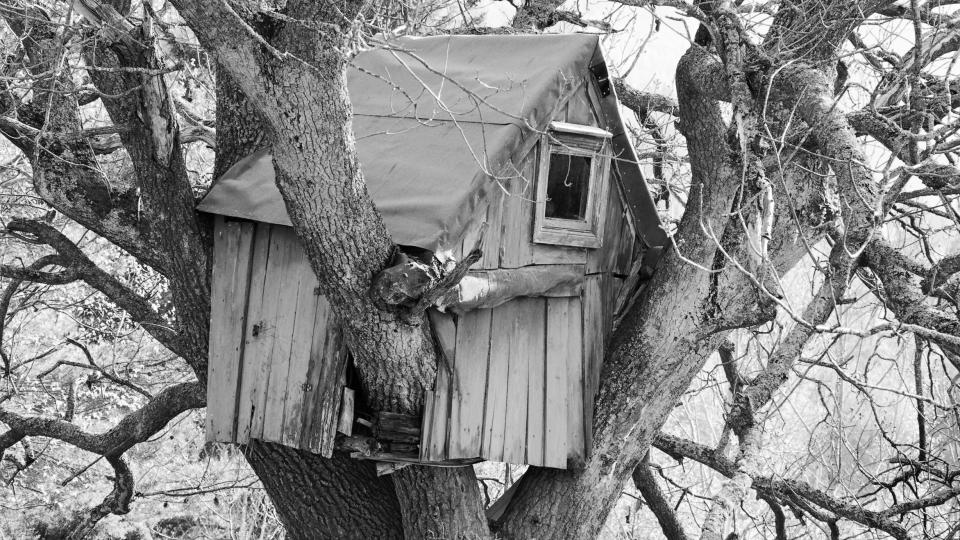
The unknown


: We don´t know how we got here,
or where we are.
We do not know who was here before us,
or where they are now.
We dont even know if they were the ones
that made thís scene.
All we know is that this "home" is very
much alive, and i think we just moved in.

7.9.09

Locality 41 (Lindesnes) Transitory

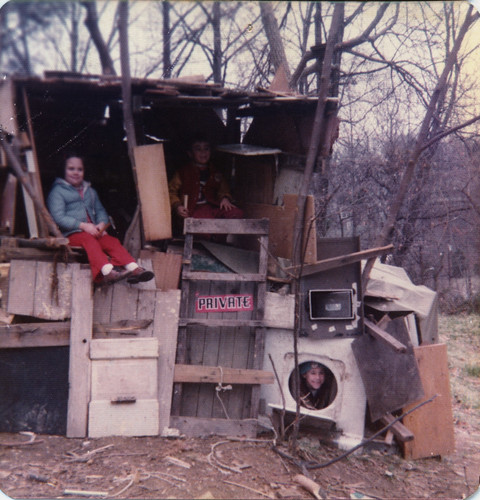
At Lindesnes Bygdemuseum, this photo depicts two young architects that were never properly credited for their work. Around 1964 (judging from other contemporary photos), Atti Eikaas on the roof, and Odd Terje Vigeland in the doorway, built this magnificent hut. Now the photo is all that remains of it. Apparently, only buildings constructed by adults are worthy of preservation.

Kid huts may compare better to Buddhist sand mandalas. A sand mandala is ritualistically destroyed once it has been completed and its accompanying ceremonies and viewing are finished to symbolize the Buddhist doctrinal belief in the transitory nature of material life. It is the doing that is important, not the artefact. Childhood is transitory. But then again, so is adulthood.

2.9.09

Locality 40 (Arlington, VA, USA) Down memory lane

On the first of May, 1977, at latitude 38.893036 and longitude 77.10101, expedition member Ken Mayer came into the view of a camera lense. The 3-story monstrosity was built from scrap found along the I-66 right-of-way, where torn down houses and businesses along the former railroad line provided plenty of materials.

"I often feel that city-planners fail to recognize the need for free spaces for kids to create their own stuff. In our case, a 20-year fight over an interstate highway created a great over-grown no-man's-land of ruins and forest" says Mayer in a retrospective comment. Although clearly marked "Private", the remains of the hut are now buried below the highway, waiting to be rediscovered.

30.7.09

Locality 39 (Aigle, Switzerland) Unintended Installation

In the forest, near "Aigle", Switzerland, artist and explorer Nicolas Geiser came across this kid hut on slim tree stilts, reachable by a long ladder made of two poles with plank steps. The hut is constructed so that no two boards are alike, nor of the same length. And the "door" is actually a rug. Creativity is the mother of invention.

9.7.09

Locality 38 (Arendal) Ascent at Paradise Bay

Using our expedition boat, a GH 14 with a Yamaha 9,9 HP outboard motor, we are now able to navigate into unexplored bays and islets in the archipelago outside the South Coast of Norway. At Paradise Bay on the small island Havsøy outside of Arendal, a large Ash invited itself to be explored. Somebody had mounted a small swing from one of the branches. At the top of the tree we thought we could discern a small tree hut, but could not be sure from our position on the ground.
Choosing a moment when no-one seemed near, we leapt sinuous and catlike, into the lower branches of the forest giant. Silently we climbed to a great height until we found a point where we could look through a leafy opening upon the scene beneath us.


We had now ascended to the structure we could discern from the ground, and from this angle we realized that it was more of a look-out tower at the top of the forest canopy than a proper hut. A floor, but no walls or roof, the structure was nevertheless sturdily built, and the bent spikes told the tale about the young builders. How on earth they had managed to get up there remained a mystery until we found remains of past ropes that in the past must have made the ascent at Paradise Bay a breeze.

1.7.09

Locality 37 (Northwest Pennsylvania, US) Anaglyph

Ah, the wonders of MODERN SCIENCE! Thanks to the TECHNOLOGICAL ADVANCEMENTS of the 19th century, explorer Ian5281 has provided us with an anaglyph of a snow fort discovered in northwest Pennsylvania, US. This AMAZING STEREOSCOPIC IMAGE may be FULLY appreciated by explorers equipped with a standard set of 3d glasses, such as the one depicted below. NO EXPLORER WOULD DARE LEAVE HOME WITHOUT IT!


Ah, how fitting that this EXOTIC PHOTOGRAPH of a snow fort should be featured on this summer edition of our INQUISITIVE AND INFORMATIVE BLOG, looking into the MYSTERIES OF CHILDHOOD. We wish our fellow explorers a HAPPY SUMMER HOLIDAY! And do beware of those ULTRAVIOLET RAYS. Tans may come and go, but MEMORIES LAST FOREVER!

18.5.09

Locality 36 (Martinsburg, West Virginia) Simple Living


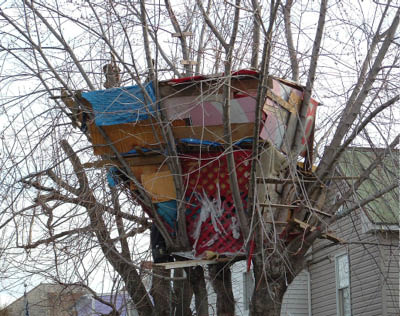
Explorer Dr. Boden managed to document this tree construction in Martinsburg, West Virginia before the city made the young constructor James demolish the site on claims it was an "eye sore". But with this more substantial shelter about him, he had made some progress toward settling in the world. This frame, so slightly clad, was a sort of crystallization around him, and reacted on the builder. It was suggestive, somewhat as a picture in outlines. He did not need to go outdoors to take the air, for the atmosphere within had lost none of its freshness. "An abode without birds is like a meat without seasoning".

4.5.09

Det norske huset


Frode Grytten and photographer Jens Hauge have been on extensive kid hut expeditions and present their reports in the book "Det norske huset". According to Dagbladet, the starting point for the book project was close to 70 b/w photographies of Norwegian kid huts, documented by Hauge across the last 20 years, everything from small shacks in the trees, sheet metal huts and snow castles to strange tunnelways, crooked verandas and more elaborate constructions resembling art installations. . .

13.4.09

Locality 27-35 (Fevik) A Survey


We now publish the preliminary results of the survey conducted within the Søm-Ruagerkilen Nature Reserve at Fevik, Norway. The area only became protected in 2006, and contains a birch forest housing a wealth of biological diversity, as well as the Ruagerkilen lagoon sheltered from the open sea and containing a number of sea birds.

The survey discovered as many as 9 different localities within the area. The density of huts was particularly striking in the immediate proximity to the lagoon itself, making it likely that the same constructors were responsible for most of these huts. All of these were basic tree huts at various stages of completion, constructed mainly from wooden boards.


However, there were also two other localities that displayed a completely different culture, notably locality 27, and 32. The former was in fact the most concealed site, located only 20-25 metres from a dirt road at the outskirts of the forest, and the last to be discovered. The site consisted of a sort of rough A-shape shelter built from tree branches and some additional tarpauling. The attempt at concealing the hut makes sense given that it was actually located within the protected forest, making it illegal. However, all of these localities were actually within the protected area.


The only other hut bearing any likeness to loc. 27, was loc. 32, which was found within the protected forest itself. This was also constructed in the manner of a shelter, although missing a full cover. An old hand saw was found at the site, perhaps suggesting that the hut was of considerable age and may have been built before the area became protected. However, it should be noted that both these latter localities were ecologically built, using rope and branches and carefully blending in with the landscape, on the border of making them invisible.

7.4.09

Locality 26 (Basel, Switzerland) The Lilliputians are coming

Intrepid explorer Gulliver Lorpailleur discovered this miniature construction 3/4 up a street lamp in Basel. Obviously the constructors must be illegal immigrants from a remote nation of the world. "Hekhinah Degul" indeed.

29.3.09

Locality 25 (Port Allen, Louisiana, US) The Castle

American explorer bmooneyatwork documented this castle in 2007 across the river from Baton Rouge and under the carport. The castle may or may not inhabit Basquiat's spirit.

7.3.09

Locality 24 (San Luis Obispo CA, US) The Giving Tree


Veteran explorer Aroid shares stories about the hut next to the Cypress tree in his family's back yard in August 1960.

"Chuck had his fort in this tree, using bike crates for wood. Then he cut off key branches to keep us from gaining access. He tore down the fort--as much fun as building it.

Mom had something to say about us building our own fort. Clearly she did not get it. Munther the gardener built us a "nice" fort, with a concrete floor, properly put together. You can see it there, the first storey, with what was a window.

Then we took over, adding stories and taking it up into the old cypress tree.

I was always surprised how junky mom let us make this area. Then one day she suggested we clean it up, and we tore the fort down. The end of an era. Then she had the whole area professionally landscaped and it lost all interest for us. Became like a mall or a development. I guess she figured it was time, and she was right. "

1. I spent many an afternoon around here, and noticed a Painted Lady butterfly made regular rounds, often landing near the tree.
2. Chuck
cut off a key low-hanging branch right here, that you had to swing over to get up into the tree. without it us short kids could not climb it. we may have had a way into the tree by using the fence.
3.
The tree had resin exuding from it, which we got on our hands, and smelled of. The bark was redder below, and shredded. It had tiny green splotches on it.
4.
Each of these branches, and crevices was familiar to me, how you had to stretch to get across them, it all seemed wonderfully primal, but i did not know that word at the time. It was exciting to climb as high as you could.
5.
We spent a lot of time climbing around in this tree. When friends would come over I was surprised they could not scramble around in it also, because it was unfamiliar to them. It had become second nature to me. I love being up in trees, looking out.
6.
Perhaps the most foolish thing I ever did was climb to the top of this tree with a coil of steel cable and throw it out and over the power line to the left. When it hit the ground all hell broke loose. Sparks flew, cable was being where it crossed the wires, and falling to the ground.
7.
We got bags of new nails at Forden's Hdwr. Freddy Waters noted that we wasted nails when we had a lot of them, and were very careful when we were just about out. That always stuck in my head, his observation.
8. Chuck
showed us how to straighten bent nails with a hammer and use them again. He was always hammering and building things as a child.
9.
A second cypress tree grew off to the left, but it was always a runt. I climbed up in it once all by myself, must have been really little, and got stuck, and Mr. Gillardi had to be summoned to get me out.
10.
this fence was taken down and replaced as part of the new order, about 1961, and nasty ivy was planted all around, and boring shrubs.

3.3.09

Locality 23 (Dunstan, England) Cottage Inn

Explorer Rojabro reports that "In addition to a large children's play area, there is a tree house in the woods at the Cottage Inn in Dunstan. near Craster and Dunstanburgh Castle"

8.2.09

Locality 22 (Crespano del Grappa, Italy) Child dream

Expedition member Stezz managed to photograph this deserted tree hut at these coordinates: 45°50'17"N, 11°49'57"E, noting that it was "every child's dream". Voglio vivere su un albero...

31.1.09

Locality 20 (San Fransisco) In the mission

In the following, we will post photos and short reports from Kid Hut Expedition members all over the world through our Explorers club on Flickr. The first post in this series derives from Expedition member Drain's explorations in San Fransisco, US., Albion Street near 17th. "In the mission...I wonder who stays there".

26.1.09

Locality 19: What the snow covered (Arendal)

Our expedition embarked into the unexplored forest area that stretches from the public cemetery in Arendal and into the interior parts of the god forsaken country. The weather was treacherous, with snow falling heavily from the dense forest canopy above and covering what remained of footpaths. At times, the trail felt as impassable as it must have been for Roald Amundsen on his arctic treks.


It is not always the shortest way that is the best; here, in any case, it was to be hoped that another and longer one would offer better conditions. The shortest way was awful — possibly not altogether impracticable, if no better was to be found. First we had to work our way across a hard, forested slope, which formed an angle of 45 degrees, and ended in a huge, bottomless chasm. It was no great pleasure to cross over here on ski, but with heavily-laden sledges the enjoyment would be still less.

The prospect of seeing sledge, driver, and dogs slide down sideways and disappear into the abyss was a great one. We got across with whole skins on ski, and continued our exploration. Now came the great question: What was there on the other side of the ridge? Was it the same desperate confusion, or would the ground offer better facilities? Three of us went off to see. Excitement rose as we neared the saddle.

Partly concealed in the snow, we came across what appeared to us as an ancient Indian burial ground, similar to the ones found in the Mid-West parts of what is now USA.The fact that we were not able to find any remains of human bones at the site, may suggest that local birds of prey had already devoured the corpses according to custom.

14.11.08

Locality 18 (Kragerø) The Lost Tribe


Kragerø, Norway. One of Norway's last uncontacted tribes has been spotted in the far southern jungle near the coast.

The tribe was sighted in an Environmental Protected Area surrounding Kalstadtjenna in a recent survey. Expedition members said they photographed "strong and healthy" warriors, a hut and a large planted area. But it was not known to which tribe they belonged, the group said.

"Four distinct isolated peoples exist in this region, whom we have accompanied for 20 years," a local expert said in a statement.

The tribe sighted recently is one of the last not to be contacted by officials. The group does not make contact with such tribes and prevents invasions of their land to ensure their autonomy, a spokesman said.

Survival International said the tribe is in danger from illegal logging which is driving tribes over the county border and could lead to conflict with uncontacted tribes now living on the Aust-Agder side.

There are more than 100 uncontacted tribes worldwide, the group said in a statement. "These pictures are further evidence that uncontacted tribes really do exist," an expedition member said. "The world needs to wake up to this, and ensure that their territory is protected in accordance with international law. Otherwise, they will soon be made extinct."

20.10.08

Locality 17 (Arendal) The Hidden Valley

Upon our recent expedition in the Stinta area of Arendal we came across a hidden valley in the middle of an otherwise densely populated are on the outskirts of the small town centre. We had entered a marvelous canyon above what appeared to be several sites of abandoned ruins. A hidden path at Stintetoppen ran through a land of matchless charm. It had the majestic grandeur of the Canadian Rockies, as well as the startling beauty of the Nuuanu Pali near Honolulu, and the enchanting vistas of the Koolau Ditch Trail on Maui.

In the variety of its charms the power of its spell, I know of no place in the world which can compare with it. Not only had it small peaks looming below the clouds overhead; gigantic precipices of many-coloured granite rising sheer for hundreds of feet above the valley, it had also, in striking contrast, orchids and tree ferns, the delectable beauty of luxurious vegetation and the mysterious witchery of the jungle. One was drawn irrisistibly onwards by ever-recurring surprises through a deep, winding gorge, turing and twisting past overhanging cliffs of considerable height.

Above all, there was the fascination of finding here and there under swaying vines, or perched on top of a beetling crag, the remains of a bygone race; and of trying to understand the bewildering romance of the ancient builders who, ages ago, sought refuge in a region which appears to have been expressly designed by nature as a sanctuary for the oppressed, a place where they might fearlessly and patiently give expression to their passion for wooden walls of passable beauty.

Traversing the valley, our expedition suddenly encountered a wild animal watching us from a ledge above the concealed jungle trail. One of the native porters suggested that this mysterious golden cat creature was an animal spirit, a ch’unel, a supernatural companion with an intertwined fate with a Shaman. The conclusion was drawn that the past valley inhabitants had somehow managed to transform themselves into animal spirits to protect the valley sanctuary which we were trespassing. While the porters abandoned our gear and hastily returned to their villages, the wild cat disappeared into the jungle never to be seen again.

11.9.08

Locality 16 (Arendal) Tree swing

Our expedition along Nidelva uncovered the remains of an interesting site. Not far from the outlet of the river at Hisøya, a tree swing had been mounted next to a small pristine beach. Our footsteps seemed to be the first ever, and there were no signs of native tribes.

Access to mount the swing was provided by a series of wooden steps assembled in the tree trunk. Some of the steps showed signs of wear and had clearly not been maintained since they had been constructed.

The site closely resembled the hidden-away look out sites known from Edgar Rice Burroughs' books on Tarzan. Concealed in the foliage, a person could keep a close watch on his surroundings, diving into the river at will to save a drowning virgin.